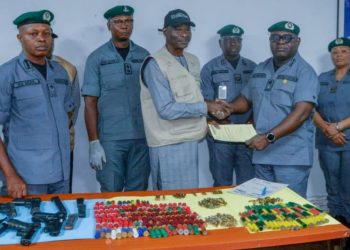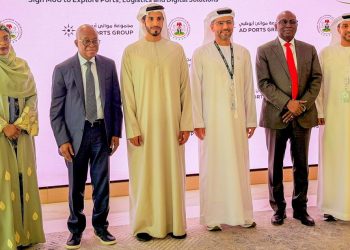

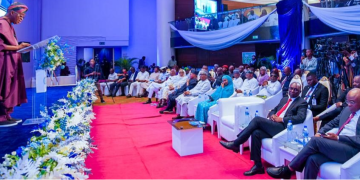
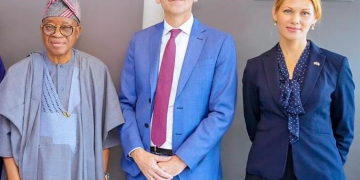
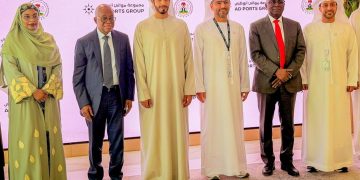





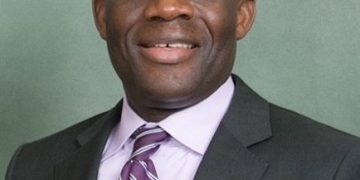











- Managing Director/Chief Executive Officer of Lekki Port LFTZ Enterprise Limited, Wang Qiang, and other heads of organisation and Lekki Freeport Terminal during a media parley in Lagos.. Tuesday
By Anthony Nwachukwu
The management of the Lekki Deep Sea Port has stressed the need for all stakeholders, including government agencies, port users and financial institutions, to fully align with the facility’s end-to-end digital processes to enable everyone enjoy the benefits of the port’s already full automation.

This is as the it stated that the port has almost attained half of its designed operational capacity, with steady month-on-month growth in container throughput since September.
Making these remarks at the facility on Tuesday during an experiential visit by newsmen, the Managing Director/Chief Executive Officer of Lekki Port LFTZ Enterprise Limited, Mr. Wang Qiang, stated that Lekki Port is a fully automated terminal.
However, he noted that delays in its operations may persist until all stakeholders align with its end-to-end digital processes. He explained that Customs procedures, particularly physical cargo examinations, and other port services must be fully digitalised to significantly reduce cargo dwell time.
Noting that integration between the customs system, terminal operating system and customers is already part of an agreed implementation schedule, Qiang maintained that the facility “must work together very closely with customers and all categories of operations for automation to yield results.
According to him, “for automation to work efficiently, all players – customers, government and every stakeholder – must be ready. Only then can we have a fantastic system.”
He further stressed that improved connectivity will enable the port to effectively double its capacity through performance optimization, without expanding its physical footprint.
Meanwhile, Qiang disclosed that the port is now operating at close to 50 per cent capacity, reflecting increased confidence by shipping lines and cargo owners in Nigeria’s first deep seaport.
He said that “almost 50 per cent of the port capacity” has already been attained, with consistent improvement in the number of twenty-foot equivalent units (TEUs) handled monthly.
On cargo evacuation, he stressed the imperative of an efficient multimodal connectivity as critical to sustaining and accelerating growth at the port. According to him, barge operations have become an important evacuation channel and currently accounts for about 10 per cent of cargo movement from the port.
Qiang added that the ongoing Lagos–Calabar Coastal Road project would help ease congestion and improve access to the port, noting, however, that rail connectivity remains essential, particularly given the scale of industrial activities emerging within the Lekki corridor.
“I believe the train option is something the government is concerned about, and with the level of industrial activities in this region, we expect that it will be provided,” he said.